
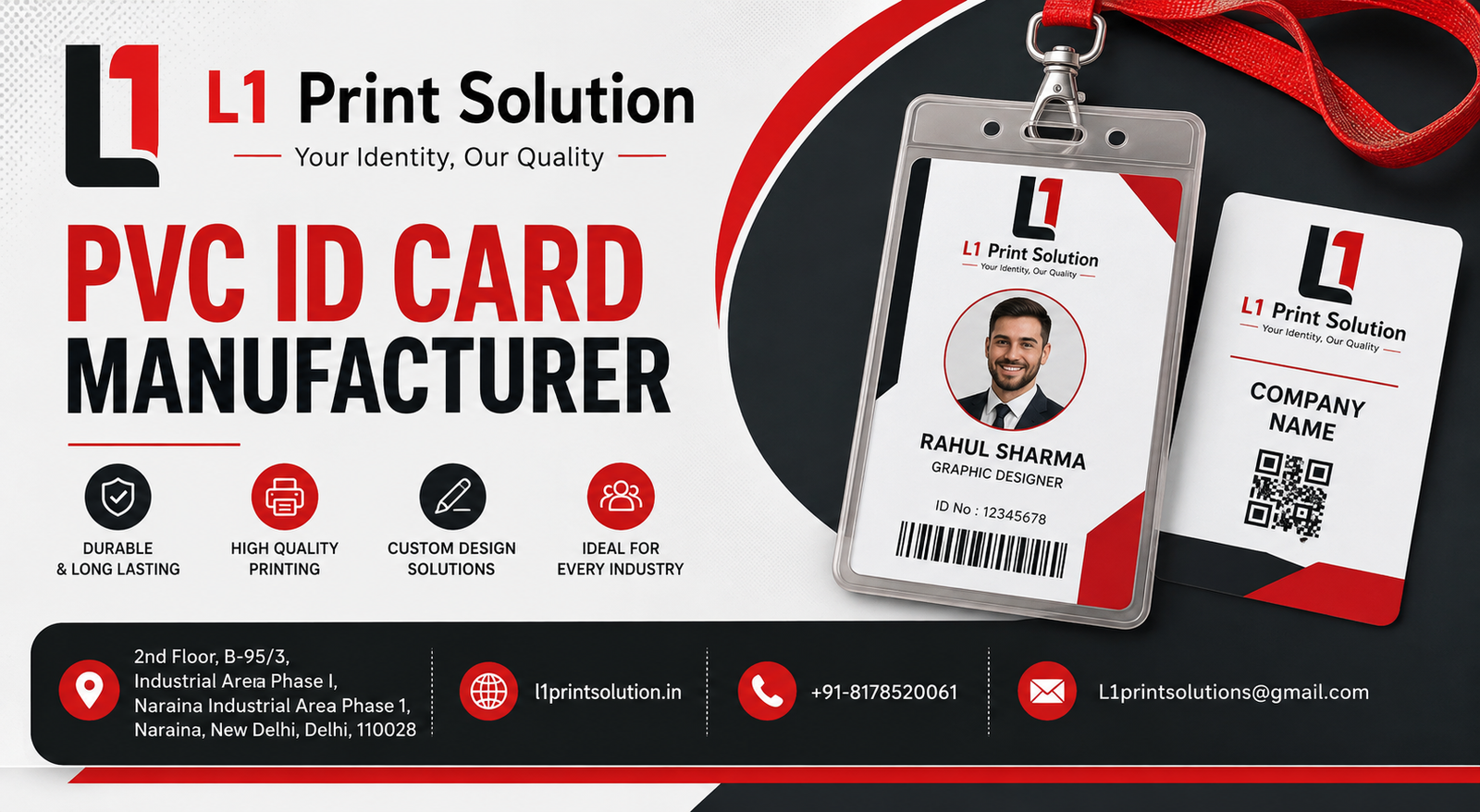
Before choosing a PVC ID Card Manufacturer, check the card material quality, thickness, printing method (direct-to-card or retransfer), lamination, and personalization options such as photos, QR codes, and barcodes. A reliable manufacturer should offer design support, sample proofs, quality checks, and clear turnaround timelines rather than competing only on the lowest price.
Introduction
At some point, most offices, schools, and institutions face the same problem: the ID cards in circulation have started to peel, fade, or crack at the edges. A card that looked sharp a year ago is now hard to scan, embarrassing to hand over at a reception desk, or simply falling apart in someone’s wallet. When this happens, the natural next step is to look for a replacement supplier — and that’s usually when people realize how much variation exists between one PVC ID card and another.
The difference often comes down to four things: the quality of the card material, the printing technology used, how the card is personalized, and the finishing applied before it’s handed over. A PVC ID Card Manufacturer that understands these variables can produce a card that holds up to daily handling for years. One that doesn’t may deliver something that looks fine on day one and starts degrading within months.
This guide walks through what actually goes into a good PVC ID card, so you can evaluate suppliers with more confidence — regardless of whether you’re ordering ten cards for a small team or ten thousand for a large institution.
What is a PVC ID Card?
PVC stands for polyvinyl chloride, a durable plastic material widely used for identification cards because of its rigidity, smooth printable surface, and resistance to everyday wear. A standard PVC ID card is built from one or more layers of PVC sheet, often laminated with a protective overlay, and printed with text, photographs, and design elements.
Most ID cards follow the CR80 format — roughly credit-card sized, at about 85.6mm x 54mm — which is why they fit standard card holders, lanyards, and printer trays used across industries.
The key difference between a PVC card and a paper-based ID card is longevity. Paper cards, even when laminated with a pouch, tend to bend, tear at the corners, or let moisture in over time. PVC cards resist this because the material itself is the structural layer, not just a covering.
You’ll find PVC cards used for:
- Employee identification in offices
- Student and staff ID cards in schools and colleges
- Visitor and event passes
- Membership cards for clubs and associations
- Access cards paired with barcodes or magnetic stripes
Why PVC is a Popular Material for ID Cards
PVC has become the default material for identification cards for a few practical reasons:
- Durability: It resists everyday bending, minor drops, and surface scuffing better than paper or laminated card stock.
- Lightweight construction: Easy to carry in a wallet, pocket, or on a lanyard without adding bulk.
- Water resistance: A card left in a bag during rain or spilled on at a desk won’t disintegrate the way paper does.
- Professional appearance: The smooth, glossy or matte finish gives a cleaner, more polished look than laminated paper.
- Easy personalization: PVC surfaces accept high-resolution printing well, including photographs, logos, and fine text.
- Compatibility with card printers: Most desktop and industrial ID card printers are designed specifically for PVC card stock, making reprints and batch production straightforward.
It’s worth being realistic here — PVC cards are durable for typical everyday use, but exact lifespan depends on card quality, handling frequency, and storage conditions rather than any fixed number of years.
PVC ID Card Materials and Thickness
Not all PVC cards are made the same way. Thickness and construction affect how a card performs over time, and choosing the right specification depends on how the card will actually be used.
| Card Specification | Typical Use | Key Advantage |
| 0.50mm PVC | Short-term event badges, temporary passes | Cost-effective for one-time or limited use |
| 0.76mm PVC (standard) | Employee ID cards, school ID cards, membership cards | Balanced durability and cost for daily handling |
| 0.80mm–1.0mm PVC | High-frequency use, access-control cards | Extra rigidity for cards used multiple times daily |
| Composite/PVC-PET blend | Cards needing extra flex resistance | Reduced cracking under repeated bending |
The general principle: organizations issuing cards for daily, long-term use — like employee or student IDs — benefit from thicker, standard-grade PVC, while short-term event or visitor passes can reasonably use thinner, more economical stock. Choosing based on usage rather than price alone helps avoid replacing cards more often than necessary.
PVC ID Card Printing Methods Explained
The printing method used affects image sharpness, color accuracy, and how well the card holds up over time. It’s a separate consideration from personalization (the actual data printed on each card).
Direct-to-Card Printing
This is the most common method for standard ID cards. The printer applies dye or resin directly onto the surface of the card. It’s efficient for both single cards and moderate batch runs, producing clear text and reasonably sharp photo reproduction. It’s well suited for employee IDs, student cards, and general office use.
Retransfer Printing
In this method, the image is printed onto a film first, which is then fused onto the card under heat and pressure. This allows printing to extend fully to the card edges and produces sharper detail, particularly for photographs and fine graphics. It’s often preferred for cards that need a more premium finish or include detailed security elements.
Digital Printing
Digital printing is commonly used for short-to-medium production runs where each card may need slightly different design elements, such as department-specific colors or varying QR codes. It offers flexibility without requiring separate printing plates or setups for each variation.
What Makes a PVC ID Card Durable?
Durability isn’t determined by a single factor — it’s the combination of several elements:
- PVC material quality: Lower-grade PVC can become brittle or discolor faster.
- Card thickness: Thicker cards generally resist bending and cracking better.
- Print quality: Poor resolution can fade or blur faster under handling.
- Lamination: A laminate overlay protects printed details from scratches and fading.
- Surface finishing: Matte or gloss finishes affect scratch visibility and grip.
- Handling frequency: Cards swiped or handled multiple times daily wear faster than occasional-use cards.
- Storage: Cards left in direct sunlight or extreme heat degrade faster than those in holders or wallets.
- Accessories: Card holders and lanyards reduce direct contact wear significantly.
As a practical comparison: an employee ID card used daily for building access, swiped at multiple checkpoints, and carried in a pocket needs thicker PVC, strong lamination, and a durable print method. A temporary event badge worn for a single day doesn’t need the same specification — thinner stock and standard printing are usually sufficient, and spending more on premium material here isn’t necessary.
Customization Options for PVC ID Cards
Modern PVC ID cards can include a range of personalization elements, though not every card needs every feature. Common options include:
- Employee or student name
- Photograph
- Employee or roll number
- Department
- Designation
- Company or institution logo
- School/college details
- Barcode
- QR code
- Signature panel
- Magnetic stripe (for access or attendance systems)
- Holographic security features (for high-security environments)
A basic employee ID might only need a name, photo, department, and logo, while a card used for building access or attendance tracking may also require a barcode, QR code, or magnetic stripe. Matching features to actual use avoids unnecessary cost and complexity.
Where Are PVC ID Cards Used?
| Industry | Typical Card | Common Purpose |
| Corporate offices | Employee ID card | Identification, access control |
| Schools | Student ID card | Identification, library/attendance |
| Colleges | Student/staff ID card | Identification, campus access |
| Hospitals | Staff ID card | Identification, department access |
| Membership organizations | Membership card | Verification, benefits tracking |
| Retail businesses | Employee/loyalty card | Identification, customer programs |
| Events | Event badge/pass | Entry verification |
| Clubs | Membership card | Access, identification |
| Institutions | Visitor/staff card | Security, visitor management |
How to Choose the Right PVC ID Card Manufacturer
Selecting a manufacturer involves more than comparing quotes. A few areas are worth evaluating directly:
- Material quality: Ask what grade and thickness of PVC is used.
- Printing quality: Request sample cards to check sharpness and color accuracy.
- Design support: Does the manufacturer help with layout, or do you need to supply print-ready files?
- Personalization capability: Can they handle variable data printing (names, photos, IDs) accurately at scale?
- Bulk production capacity: Can they handle your quantity within your timeline?
- Turnaround time: Confirm realistic production and delivery windows, especially for urgent orders.
- Quality control: Ask how they check for printing errors or defects before dispatch.
- Packaging: Bulk orders should be packed to prevent scratching or bending in transit.
- Customer support: Responsive communication matters, especially for corrections or reorders.
- Pricing transparency: Understand what’s included — material, printing, lamination, and delivery — rather than comparing bare unit prices.
Price matters, but the lowest quote often reflects thinner material or lower print resolution. It’s usually more useful to compare like-for-like specifications across suppliers rather than price alone.
Questions to Ask Before Placing an Order
- What card material and thickness will be used?
- Is single- or double-sided printing available?
- Can employee/student data be personalized accurately?
- Can photographs and QR/barcodes be printed clearly?
- Is lamination available, and what type?
- Can samples or proofs be reviewed before bulk printing?
- What is the expected production timeline?
- How are bulk orders quality-checked before dispatch?
Common Mistakes When Ordering PVC ID Cards
- Choosing only based on price: Often leads to thinner material or lower print quality than expected.
- Not checking card samples: Skipping this step means design or color issues surface only after bulk printing.
- Providing inaccurate personalization data: Errors in names, IDs, or photos become costly to fix after printing.
- Ignoring print resolution: Low-resolution photos or logos print blurry regardless of card quality.
- Not confirming card thickness: Leads to mismatched durability expectations for the intended use case.
- Failing to check QR/barcode readability: A code that doesn’t scan defeats its purpose.
- Ordering without confirming delivery requirements: Can result in missed deadlines for events or onboarding schedules.
Each of these mistakes is avoidable with a short round of confirmation before full production begins.
PVC ID Card Buying Checklist
| Requirement | What to Check |
| Material | PVC quality and thickness |
| Design | Logo, colors, layout accuracy |
| Printing | Sharpness and color accuracy |
| Personalization | Names, photos, ID numbers |
| Security | QR code, barcode, hologram (if needed) |
| Finish | Matte, gloss, or lamination |
| Quantity | Small batch or bulk requirement |
| Delivery | Production and dispatch timeline |
How L1 Print Solution Can Help
L1 Print Solution works with organizations that need PVC ID cards produced to a consistent standard — whether that’s a small batch of employee cards or a larger order for a school, college, or corporate office. The focus is on understanding what the card will actually be used for, so the material thickness, printing method, and finishing match the requirement rather than defaulting to a one-size-fits-all approach.
For businesses in Delhi and the surrounding region looking for PVC ID card printing services, L1 Print Solution supports design coordination, personalization (names, photos, QR/barcodes), and production for both small and bulk orders. If you’re planning a fresh batch of employee, school, or office ID cards, it’s worth discussing your specific requirements before finalizing a supplier.
FAQs
What is a PVC ID card?
A PVC ID card is an identification card made from polyvinyl chloride plastic, typically printed with a photo, name, and other identifying details. It’s more durable than paper-based ID cards and is used across offices, schools, and institutions.
How durable are PVC ID cards?
PVC ID cards generally hold up well to daily handling, resisting bending, moisture, and surface wear better than paper cards. Actual durability depends on material thickness, print quality, lamination, and how the card is stored and used.
What should I look for in a PVC ID Card Manufacturer?
Check material quality and thickness, printing method, personalization accuracy, sample availability, production timelines, and quality-control practices. Pricing transparency matters too — compare specifications, not just quoted price.
Can PVC ID cards include QR codes and barcodes?
Yes. PVC ID cards commonly include QR codes and barcodes for attendance tracking, access control, or verification purposes, printed directly onto the card during production.
Are PVC ID cards suitable for offices and schools?
Yes. Offices commonly use PVC cards for employee identification and access control, while schools and colleges use them for student and staff identification, library access, and attendance tracking.
Conclusion
Choosing a PVC ID card comes down to matching material, printing method, personalization, and durability to how the card will actually be used — a daily-use employee card has different needs than a one-day event badge. Working with a manufacturer that’s transparent about these specifications, offers sample proofs, and maintains consistent quality control makes it easier to get a card that holds up as expected, rather than one that needs replacing sooner than planned.
Visit: https://l1printsolution.in/
Call: +91-8178520061
Email: L1printsolutions@gmail.com
Address: 2nd Floor, B-95/3, Industrial Area Phase I, Naraina Industrial Area Phase 1, Naraina, New Delhi, Delhi, 110028