
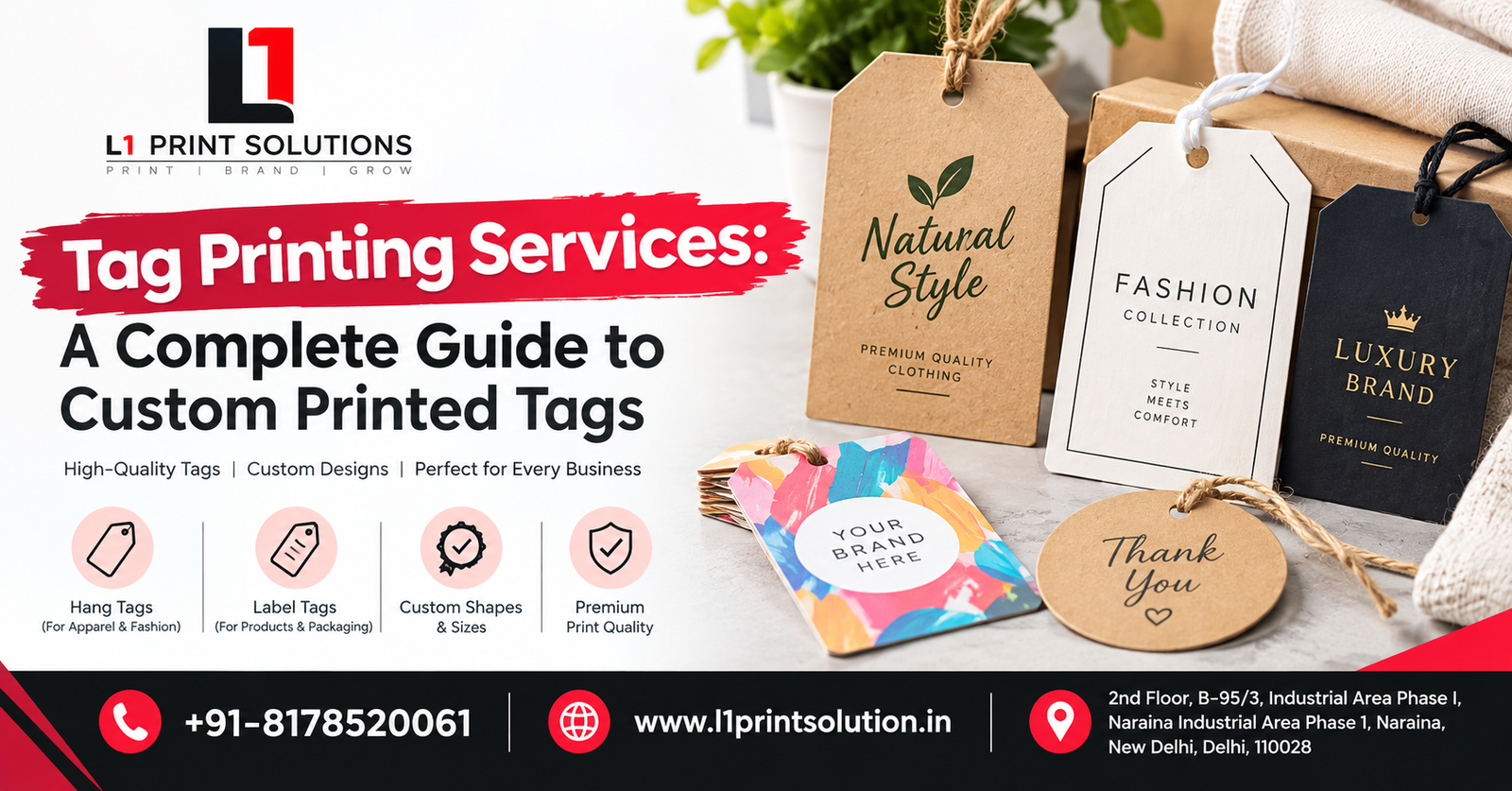
A tag is often the first piece of printed information a customer reads about a product. It tells them who made it, what it is, and sometimes what it costs. Whether it hangs from a shirt, sits on a gift box or goes out with a promotional kit, a well-planned tag helps a business present its products clearly and consistently.
Tags are used on garments, accessories, retail products, gifts, packaging and promotional items. This guide explains the main tag types, what to consider when choosing specifications, what to print on a tag, and how to prepare for a bulk order, so you can make informed decisions before you approach a printer.
What Are Custom Printed Tags?
Custom printed tags are small printed labels made to a business’s own specifications. Businesses personalise them with brand names, logos, product details, prices, product codes or promotional messages. What goes on the tag depends on the product category and the job the tag has to do.
It helps to separate two purposes:
- Branding tags focus on presentation. They carry a logo, brand colours and perhaps a short message or website address.
- Identification and information tags focus on practical details such as product name, code, size or price.
Many tags do both. Deciding which purpose matters more will guide your choices on layout, size and material.
Different Types of Tags and Their Uses
The right tag depends on the product, the environment, how it will be used and your design requirements.
- Clothing hang tags: Used by apparel brands, boutiques and garment retailers to show branding and selected product details.
- Product tags: Used to identify products and share relevant information in retail settings.
- Price tags: Used to display pricing or product codes where appropriate.
- Packaging tags: Used alongside packaging to provide product or brand information.
- Promotional tags: Used for campaigns, events, product launches and branded giveaways.
The table below summarises these common applications.
| Tag Type | Common Application | Details to Consider |
| Clothing hang tags | Apparel and fashion retail | Brand identity, size, price, and attachment |
| Product tags | Retail and product identification | Product name, code, and readability |
| Price tags | Retail displays | Clear pricing and product identification |
| Packaging tags | Product packaging and presentation | Design consistency and packaging compatibility |
| Promotional tags | Campaigns, events, and giveaways | Brand message and campaign details |
These are general applications. The final design should be chosen according to your product and business requirements, and you should confirm with your printer which tag types they can produce.
Benefits of Using Custom Printed Tags for Business
Tags will not guarantee sales or loyalty on their own, but a thoughtful tag offers practical advantages:
- Brand recognition: Using the same logo, colours and brand name across tags helps customers recognise your business.
- Product information: Tags can show details that help customers identify or understand a product.
- Professional presentation: Clean, well-organised design improves how products look in a retail setting.
- Product organisation: Suitable tags support product identification and inventory processes.
- Marketing opportunities: A tag can carry a short message, website address or social media handle when appropriate.
How to Choose the Right Material, Size, and Finish
Settling these details early avoids costly changes later.
Material
Choose a material that suits the intended use, product requirements, budget and desired appearance. A tag for a premium garment may call for a different feel than a price tag used for short-term retail displays.
Size and Shape
The tag should have enough room for essential information without overwhelming the product. A tag that is too large can look clumsy on a small item, while a tiny one may force the text to be hard to read.
Print Colours
Select colours that stay readable and match your brand guidelines. Check that text contrasts well with the background.
Surface Finish
Consider the visual effect you want and any practical needs, such as how much handling the tag will get.
Attachment Method
Decide whether the tag needs a hole, string, loop or another attachment method, and make sure it suits the product.
Durability
Think about handling, storage, moisture exposure and the environment the tag will be used in. A tag stored in a warehouse faces different conditions from one displayed on a shop rail.
Available materials, finishes and customisation options vary between printers, so confirm them before you place an order.
What Information Should You Include on a Printed Tag?
Include what is useful for your application, and leave out the rest. Common elements are:
- Brand name and logo
- Product name or product code
- Price, where applicable
- Size or colour details, where relevant
- Care instructions, when appropriate
- Website or contact information
- QR code or social media details, when useful
A tag should stay readable and visually organised. If you add too much text, customers will struggle to find what matters. For example, a clothing hang tag might show the logo, size and price on the front and care details on the reverse, rather than crowding everything on one side.
How to Prepare for a Tag Printing Order
Planning these details in advance reduces misunderstandings and makes ordering more straightforward.
- Identify the purpose: Decide whether the tag is mainly for branding, product information, pricing or promotion.
- Determine the quantity: Estimate how many tags you need and consider future stock requirements.
- Prepare the design: Arrange the logo, text, colours and other details.
- Select specifications: Confirm dimensions, material, shape, finish and attachment requirements.
- Review the proof: Check spelling, colours, alignment and readability before approving production.
- Confirm the quotation: Ask about total cost, minimum order quantity, production schedule, delivery charges and payment terms.
- Check the finished order: Compare the delivered tags with the approved specifications.
Factors That Affect the Cost of Custom Printed Tags
Prices depend on your specifications, so a quotation is the only reliable way to know the cost. These are the common variables:
- Order quantity
- Tag dimensions and shape
- Material selection
- Number of printed sides
- Colour requirements
- Finishing and attachment options
- Design preparation requirements
- Packaging and delivery arrangements
When you compare quotations, compare them on specifications and overall requirements rather than on price alone. Two quotes are only comparable if they cover the same material, size, finish and quantity.
Why Discuss Your Requirements With L1 Print Solution?
L1 Print Solution is a customised printing and promotional products provider serving businesses and organisations. If you are considering tag printing services, you can contact the team to discuss your requirements and clarify available specifications, customisation possibilities, quantities and pricing.
To make a quotation request easier to answer, share the following:
- The intended use of the tag
- Your artwork or logo files
- Preferred dimensions
- The quantity you need
- Your desired finish
You can also view the tag printing services product page for more information.
Frequently Asked Questions About Custom Printed Tags
What information should I give a printer to get a quotation?
Share the tag’s purpose, quantity, preferred size, material and finish preferences, number of printed sides and your artwork. The more detail you provide, the more accurate the quotation will be.
How do I choose between a branding tag and an information tag?
Start with what the customer needs to know. If the tag mainly builds brand presence, focus on the logo and a short message. If it must identify the product, prioritise the name, code, size or price.
Can one tag serve several purposes?
Yes. Many tags combine branding with practical details. Keep the layout organised so the key information is easy to find.
Why does the proof matter?
The proof is your chance to catch errors in spelling, colour, alignment and layout before production starts. Reviewing it carefully helps avoid reprinting the entire order.
What affects the price of printed tags?
Quantity, size, shape, material, number of printed sides, colours, finishing, attachment options, design work and delivery all influence the quotation.
Conclusion
Good tags come from clear decisions: a suitable material, a readable layout, appropriate specifications and the right information for your product. Take time to define the tag’s purpose, review the proof carefully and compare quotations on specifications rather than price alone.
If you are looking for reliable tag printing services, L1 Print Solution is ready to discuss your custom tag requirements. Contact the team with your intended use, artwork, size, quantity and finish preferences to get started.
Contact L1 Print Solution
Whether you need hang tags for clothing, product tags or promotional tags, L1 Print Solution is happy to talk through your requirements. Get in touch with your design files, preferred dimensions, quantity and finish, and we’ll help you plan your tag printing order.
Address: 2nd Floor, B-95/3, Industrial Area Phase I, Naraina Industrial Area Phase 1, Naraina, New Delhi, Delhi, 110028
Phone: +91-8178520061
Email: L1printsolutions@gmail.com
Website: www.l1printsolution.in