
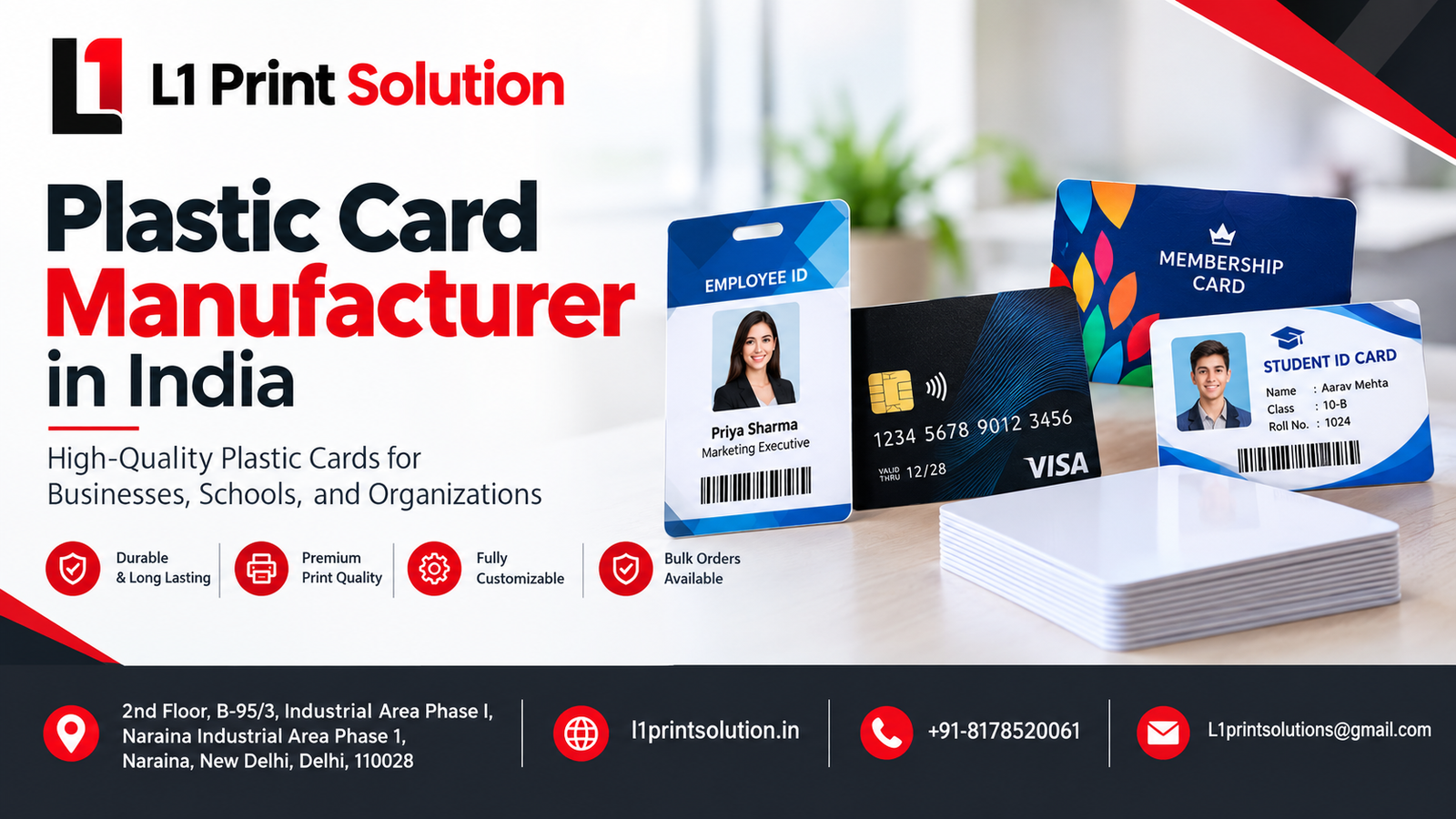
A good Plastic Card Manufacturer in India should offer quality PVC material, sharp full-color printing, accurate personalization (photos, barcodes, QR codes), reliable finishing options like lamination, and the ability to handle both small and bulk orders on time. Before ordering, check sample cards, confirm card thickness and print resolution, and ensure clear communication on pricing, turnaround, and delivery.
A school needs 800 student ID cards ready before the new academic session. A retail chain wants loyalty cards that survive daily wear in customers’ wallets. A corporate office needs employee ID cards with access-control compatibility, sharp photographs, and a professional finish. In each case, the outcome depends less on the design software used and more on who actually manufactures the card.
This is where the choice of a Plastic Card Manufacturer becomes important. Businesses, schools, clubs, retailers, and institutions across India rely on plastic cards every day for identification, access, and customer engagement — but not all cards, and not all manufacturers, are the same. Card thickness, print quality, personalization accuracy, and finishing all affect how long a card lasts and how professional it looks.
This guide explains what plastic cards are, why PVC is the preferred material, the types of cards available, how printing methods work, and what to look for when selecting a Plastic Card Manufacturer in India for a one-time or recurring order.
What Is a Plastic Card?
A plastic card is a small, rigid card typically used for identification, membership, access, or transactions. Most plastic cards used commercially in India are made from PVC (polyvinyl chloride), a durable plastic material that can be printed on, laminated, and personalized.
Basic card construction usually involves multiple layers: a core PVC layer, printed graphic layers, and an optional overlay or laminate for protection. This layered structure is what allows a card to carry a photograph, text, logo, and codes while staying flat and durable.
Common card sizes follow the standard CR80 format (roughly 85.6 mm x 54 mm, the size of a typical bank or ID card), which fits standard card printers, holders, and access-control readers.
Why plastic is preferred over paper: Paper-based ID cards tear, absorb moisture, and fade quickly. PVC cards resist bending, moisture, and daily handling far better, which is why they are the default choice for anything used repeatedly — an ID badge worn daily, a membership card carried in a wallet, or a loyalty card scanned at checkout.
Practical example: A gym issuing paper membership cards may find them worn out or unreadable within weeks. Switching to a PVC membership card with a printed barcode solves both the durability problem and gives the gym a more professional, branded look at the front desk.
Why Choose PVC Cards?
PVC cards are widely used because they offer a practical balance of durability, appearance, and functionality:
- Durability: PVC resists bending, moisture, and general wear better than paper or laminated paper cards.
- Professional appearance: A well-printed PVC card looks consistent, clean, and organization-ready, which matters for anything representing a brand or institution.
- Lightweight design: Cards are easy to carry in a wallet, lanyard, or holder without added bulk.
- Water resistance: Unlike paper, PVC does not absorb water or degrade quickly when exposed to moisture.
- Easy personalization: Names, photographs, ID numbers, and codes can be printed directly onto each card.
- Long-term usability: With proper handling, PVC cards remain functional and readable over extended use (exact lifespan varies by usage, handling, and card quality).
- Branding opportunities: Logos, brand colors, and design elements can be incorporated into the card layout.
- Compatibility with different technologies: PVC cards can be produced as simple printed cards, or combined with barcodes, QR codes, magnetic stripes, or access-control chips depending on requirement.
Types of Plastic Cards Available
Employee ID Cards
Used for workplace identification, Employee ID Cards typically display the employee’s photograph, name, designation, department, and employee ID number. They support daily identification, visitor differentiation, and can be paired with access-control systems where required.
Student ID Cards
Student ID Cards help schools, colleges, and educational institutions verify student identity for entry, library access, examinations, and transport. They usually carry the student’s photo, name, class or course, and an ID or roll number.
Membership Cards
Clubs, gyms, associations, and professional bodies use Membership Cards to identify active members, track membership status, and offer a consistent, branded touchpoint for their community.
Loyalty Cards
Retailers and service businesses use Loyalty Cards to run customer reward programs, track repeat purchases, and encourage return visits — often paired with a barcode or QR code for scanning at billing counters.
Access Cards
Access Cards are used with compatible access-control systems to manage entry into offices, residential complexes, or restricted areas. These typically require additional card technology (such as an embedded chip) beyond standard printing.
Visitor and Event Cards
Used for temporary identification, Visitor and Event Cards help institutions and event organizers track and identify guests, attendees, or short-term visitors for a defined period.
Plastic Card Printing Methods
Direct-to-Card Printing
This method prints images and text directly onto the surface of a blank PVC card using a specialized card printer. It is commonly used for single or low-to-medium volume personalized cards such as employee or student IDs, where speed and cost-efficiency matter.
Retransfer Printing
Retransfer printing first prints the image onto a film, which is then fused onto the card. This produces sharper edge-to-edge printing and works well for cards with photographs, fine text, or designs that extend to the card’s edges — useful where visual quality is a priority.
Digital Printing
Digital printing is suited for bulk production runs and highly customized designs, allowing consistent quality across large quantities. This is typically used for bulk ID card printing or large membership and loyalty card orders.
The right printing method depends on the card’s purpose, the required print quality, and the order quantity — a manufacturer should be able to recommend the appropriate method rather than applying the same process to every order.
What Makes a Quality PVC Card?
Several factors determine whether a PVC card will perform well and last:
- PVC material quality — affects flexibility, durability, and resistance to cracking
- Card thickness — standard cards are typically produced at a consistent thickness suited to card readers and holders
- Print resolution — determines how sharp text, logos, and photographs appear
- Color accuracy — ensures brand colors and images print consistently
- Photograph clarity — critical for ID and access cards used for visual verification
- Edge quality — clean-cut edges without rough or uneven borders
- Lamination — adds a protective layer against scratches and fading
- Surface finish — matte or gloss finish affects both look and feel
- Personalization accuracy — names, numbers, and photos must match records exactly
- Barcode/QR-code readability — codes must scan correctly at point of use
| Quality Factor | What to Check | Why It Matters |
| Material | PVC quality | Durability |
| Printing | Sharp text and images | Professional appearance |
| Finish | Matte/gloss/lamination | Protection and appearance |
| Personalization | Names/photos/IDs | Accurate identification |
| Codes | Barcode/QR readability | Functional reliability |
Note: Not every card needs every feature listed above. Specifications should match the intended use — an internal employee ID card may not need the same finish as a premium membership card handed to paying customers.
Customization Options
Plastic cards can be customized with a range of elements, including:
- Company logo and brand colors
- Employee photograph
- Name and designation
- Employee ID or department
- Student information (class, roll number, course)
- Membership number
- Barcode or QR code
- Signature panel
- Security elements (such as holographic overlays, where required)
- Magnetic stripe (for applicable use cases)
It’s worth noting that customers should select features based on actual requirements rather than adding elements the card doesn’t need. A simple visitor card, for instance, rarely needs a magnetic stripe or security hologram — keeping customization purposeful helps control cost and production time.
Industries That Use Plastic Cards
| Industry | Card Type | Common Purpose |
| Corporate | Employee ID | Identification |
| Education | Student ID | Student verification |
| Retail | Loyalty Card | Customer programs |
| Clubs | Membership Card | Member identification |
| Events | Event Card | Access and identification |
| Institutions | Visitor Card | Visitor management |
How to Choose a Plastic Card Manufacturer in India
Selecting the right PVC Card Manufacturer is one of the most important decisions in this process, since card quality, consistency, and reliability all depend on it. Consider evaluating a manufacturer on:
- Card material quality — ask what grade of PVC is used
- Printing quality — request sample prints before committing to an order
- Customization options — check whether the manufacturer can accommodate your specific design and data requirements
- Personalization capability — verify they can handle variable data (names, photos, IDs) accurately across large batches
- Production capacity — confirm they can realistically handle your order volume
- Bulk-order handling — ask about their process for large or recurring orders
- Quality control — understand how they check cards before dispatch
- Turnaround time — get a clear, realistic timeline in writing
- Packaging — confirm cards will be packed to prevent damage in transit
- Communication and customer support — responsiveness before and after the order matters
- Pricing transparency — costs should be clearly broken down, not vague
- Ability to handle repeat orders — useful for institutions that reorder cards periodically
Important: Do not choose a manufacturer based only on the lowest price. A cheaper quote that results in poor print quality, incorrect personalization, or delayed delivery often costs more in the long run through reprints and delays.
Plastic Card Pricing Factors
Plastic card pricing depends on several variables rather than a single fixed rate. Common factors include:
- Quantity ordered
- Card thickness
- Single- or double-sided printing
- Personalization requirements (photos, variable data)
- Finishing (matte, gloss, etc.)
- Lamination
- Special security features
- Card technology (barcode, QR, magnetic stripe, chip)
- Packaging requirements
- Delivery requirements and urgency
| Requirement | Potential Cost Impact |
| Higher quantity | May reduce per-card cost |
| Double-sided printing | Can increase production cost |
| Personalization | Depends on data requirements |
| Lamination | Adds finishing cost |
| Special features | May increase production cost |
| Urgent production | May affect pricing |
Step-by-Step Buying Process
- Define the card’s purpose — identification, access, membership, or loyalty use case.
- Decide quantity — a single batch or an ongoing bulk requirement.
- Finalize card specifications — thickness, printing sides, finish, and any special features.
- Prepare artwork and data — logo files, design layout, and personalization data (names, photos, IDs).
- Request quotation — get a clear cost and timeline breakdown from the manufacturer.
- Review sample/proof — check a physical or digital proof before full production.
- Approve production — confirm final artwork and data once satisfied with the sample.
- Check finished cards — verify a sample from the finished batch for print and personalization accuracy.
- Arrange delivery and storage — confirm packaging and delivery timelines, and store cards properly until distribution.
Common Mistakes to Avoid
- Choosing a manufacturer only by price
- Not requesting a sample before bulk production
- Submitting incorrect personalization data (names, IDs, spellings)
- Using poor-quality photographs that print unclear
- Ignoring card thickness suited to holders or readers
- Not checking QR/barcode readability before dispatch
- Failing to confirm delivery timelines in advance
- Not checking the final proof before full production begins
Quick Buying Checklist
| Checklist | Confirmed? |
| Card material | ✓ |
| Card thickness | ✓ |
| Design approved | ✓ |
| Printing sides confirmed | ✓ |
| Personalization data checked | ✓ |
| QR/barcode tested | ✓ |
| Finishing selected | ✓ |
| Quantity confirmed | ✓ |
| Delivery timeline confirmed | ✓ |
Why Work With L1 Print Solution?
L1 Print Solution works with businesses, schools, clubs, and institutions across India that need customized plastic and PVC card printing solutions. The focus is on understanding each customer’s actual requirement — whether that’s an employee ID card, a student card for a new academic session, a membership card for a growing club, or a bulk loyalty card order for a retail chain.
From design and personalization to professional printing and finishing, L1 Print Solution supports both small and bulk requirements across corporate, educational, retail, and institutional applications, aiming to make the ordering process straightforward and the final cards consistent and reliable.
FAQs
What is a plastic card manufacturer?
A plastic card manufacturer produces PVC or plastic cards used for identification, membership, access, or loyalty purposes, handling everything from material sourcing to printing, personalization, and finishing.
What types of PVC cards can a manufacturer produce?
A manufacturer can typically produce employee ID cards, student ID cards, membership cards, loyalty cards, access cards, and visitor or event cards, depending on the required specifications and technology.
How do I choose the best Plastic Card Manufacturer in India?
Evaluate manufacturers on material quality, printing quality, personalization accuracy, production capacity, turnaround time, and pricing transparency — rather than choosing based on price alone.
Are PVC cards suitable for employee and student ID cards?
Yes. PVC cards are widely used for employee and student ID cards because they are durable, easy to personalize with photos and details, and hold up well under daily use.
What information should I provide when ordering custom plastic cards?
You should provide your logo and brand colors, card design or layout preference, personalization data (names, photos, IDs), required printing sides, finishing preference, and total quantity needed.
Conclusion
Choosing the right plastic card comes down to a combination of factors working together: material quality, sharp printing, accurate customization, durable finishing, correct personalization, and a manufacturer that communicates clearly and delivers on time. Whether the requirement is a batch of employee ID cards, student cards for a new term, or loyalty cards for a retail program, the manufacturer behind the card matters as much as the design itself. Taking the time to evaluate a Plastic Card Manufacturer in India on these points — rather than on price alone — helps ensure the final cards are consistent, professional, and built to last for their intended use.
Visit: https://l1printsolution.in/
Call: +91-8178520061
Email: L1printsolutions@gmail.com
Address: 2nd Floor, B-95/3, Industrial Area Phase I, Naraina Industrial Area Phase 1, Naraina, New Delhi, Delhi, 110028