
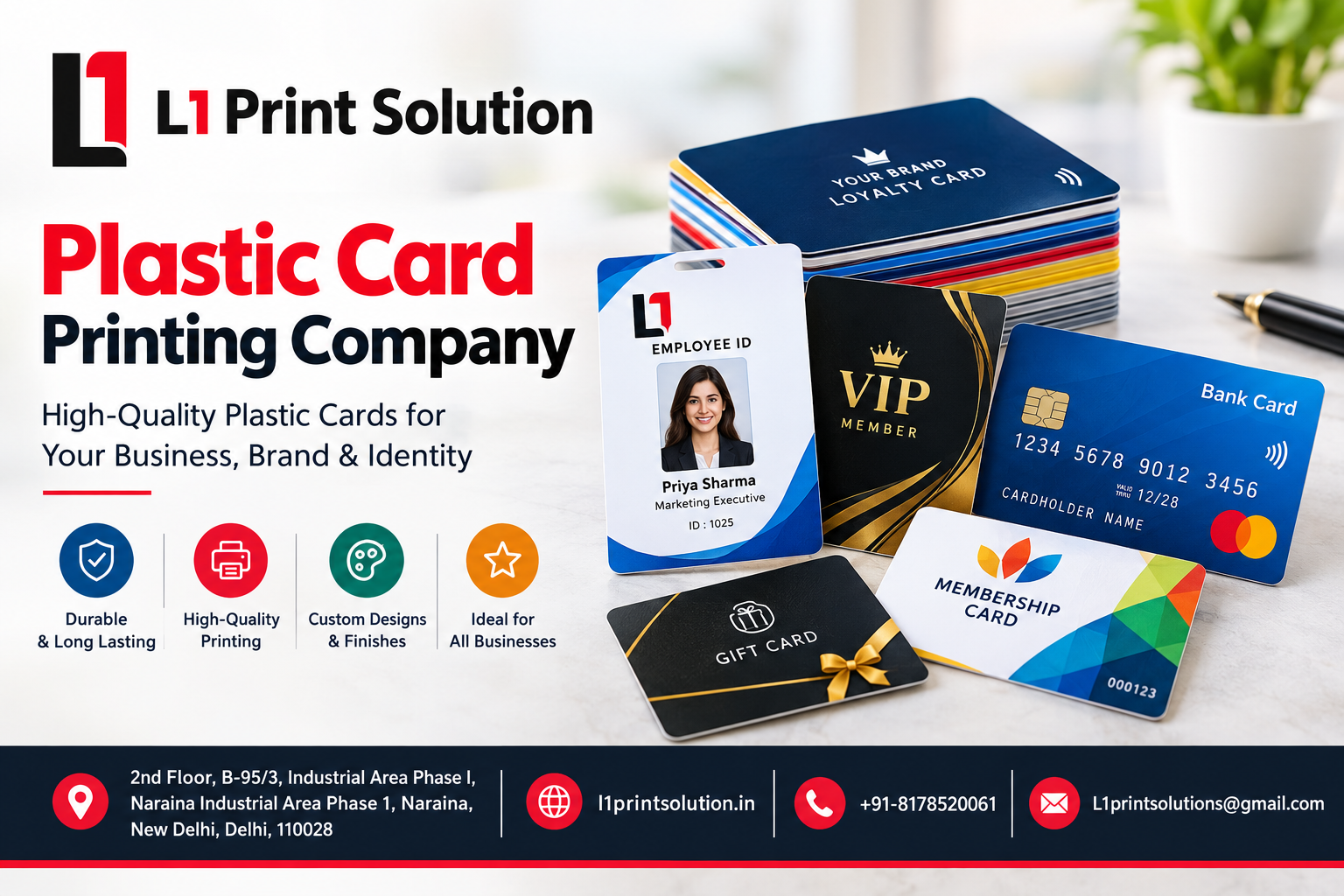
Plastic cards have quietly become one of the most-used items in daily business life. Employee ID badges, student cards, gym memberships, loyalty cards, access cards — almost every organization relies on them in some form. Yet not every card is built the same way. A poorly printed card fades, cracks, or peels within months, while a professionally produced PVC card can last for years without losing its finish. That difference usually comes down to one decision: which plastic card printing company you choose to work with.
This guide explains what a Plastic Card Printing Company actually does, what separates good PVC cards from average ones, and what to check before placing an order — whether you need 50 cards or 50,000.
Quick Answer
The best plastic card printing company offers genuine PVC card stock, sharp and consistent print quality, customization options like barcodes or QR codes, security features where needed, clear pricing, and a proof-approval step before bulk production. Reliable turnaround time and responsive customer support matter just as much as the printing itself.
What Is a Plastic Card Printing Company?
A plastic card printing company is a business that designs, personalizes, and produces cards made from PVC (polyvinyl chloride) or similar durable plastic material, rather than paper or basic laminated stock. These companies typically handle everything from artwork setup to printing, lamination, and personalization such as names, photos, barcodes, or magnetic stripes.
The key difference from ordinary paper-based card printing is durability and finish. Paper cards, even when laminated, tend to bend, tear, or discolor with regular handling. PVC cards are built to withstand daily use — being swiped, carried in wallets, exposed to moisture, or handled repeatedly — while keeping their printed design intact for a much longer period.
Why Choose Custom PVC Cards?
Custom PVC cards give organizations a way to combine practicality with a professional appearance. A few reasons businesses consistently move away from paper-based alternatives:
- Durability: PVC resists bending, water damage, and everyday wear far better than paper or basic plastic laminate.
- Professional appearance: Smooth finishing and accurate color printing make cards look credible, which matters for ID badges and membership cards that represent a brand.
- Personalization: Names, photos, ID numbers, barcodes, and QR codes can be printed individually for each cardholder.
- Longer usable life: A well-made PVC card can stay functional for years, reducing the need for frequent reprints.
- Consistent brand presentation: Logos, colors, and fonts print cleanly and consistently across every card in a batch.
Types of Plastic Cards You Can Print
Plastic card printing companies typically produce a wide range of card types depending on the client’s requirement:
- PVC ID Cards — general-purpose identification for staff, visitors, or members
- Employee ID Cards — used for identification, access, and internal security
- Student ID Cards — issued by schools and colleges for identification and library or transport access
- Membership Cards — for clubs, gyms, associations, or subscription-based services
- Loyalty Cards — used by retailers and businesses to track and reward repeat customers
- Access Cards — used with card readers for entry into offices, buildings, or restricted areas
- Visitor Cards — temporary identification for guests at corporate or institutional premises
- Event Cards — used for entry passes, exhibitor badges, or attendee identification
- Business or Promotional Cards — durable alternatives to standard paper business cards
Key Features of High-Quality Plastic Cards
Not all PVC cards are made to the same standard. Here’s what actually determines quality:
Material quality: Genuine PVC card stock feels rigid, smooth, and consistent in thickness. Lower-grade plastic can feel flimsy or warp over time.
Print clarity: Text, logos, and photos should appear sharp with no blurring, streaking, or color bleeding — especially important for ID photos and barcodes that need to scan correctly.
Color accuracy: Brand colors and logos should print consistently across every card in a batch, not vary from card to card.
Card thickness: Standard cards are typically produced around 0.76mm (similar to a bank card), which affects how the card feels and performs in card readers or printers.
Lamination: A protective laminate layer helps resist scratches, fading, and moisture damage over the card’s lifespan.
Barcode and QR code printing: These need to be printed at sufficient resolution and contrast to scan reliably with handheld or fixed scanners.
Variable data printing: This allows each card in a batch to carry unique information — names, ID numbers, photos — without manually designing every card.
Security features: Depending on use, cards may include holographic overlays, UV printing, or encoded chips/magnetic stripes for access control.
Professional finishing: Clean-cut edges, no rough corners, and a consistent finish across the entire batch.
How to Choose the Best Plastic Card Printing Company
Selecting the right printing partner involves more than comparing prices. Consider these factors:
- Material quality — Ask specifically whether cards are made from genuine PVC stock.
- Printing technology — Digital or offset printing methods affect color accuracy and detail.
- Customization capabilities — Confirm they can handle variable data, photos, barcodes, or QR codes if needed.
- Design support — Some companies assist with layout and artwork; others expect print-ready files.
- Security options — Relevant for access cards or ID cards that need to prevent duplication or misuse.
- Production capacity — Check whether they can handle your required volume within your timeline.
- Quality control — Ask how they inspect cards before dispatch.
- Turnaround time — Especially important for events or urgent staff onboarding.
- Pricing transparency — Get a clear cost breakdown rather than a vague estimate.
- Customer support — Responsiveness during design revisions and reorders is a good indicator of overall reliability.
Plastic Card Printing Process: Step by Step
While exact workflows vary between providers, most plastic card printing follows a similar sequence:
- Requirement gathering — The company understands card type, quantity, personalization needs, and any security requirements.
- Design and artwork preparation — Logos, layouts, and templates are finalized, often with a digital proof shared for approval.
- Printing — Designs are printed onto PVC card stock using digital or offset printing methods.
- Personalization — Variable details like names, photos, barcodes, or ID numbers are added per card, if required.
- Lamination and finishing — A protective layer is applied, and cards are cut to standard size with clean edges.
- Quality inspection — Cards are checked for print clarity, color consistency, and physical defects before packing.
- Delivery — Finished cards are packaged and delivered to the client, ready for use.
Plastic Card Printing Company vs. Basic Card Printing
| Factor | Plastic Card Printing Company | Basic Paper/Laminated Card Printing |
| Material | Genuine PVC, rigid and durable | Paper or thin laminate, prone to bending |
| Durability | Resists water, wear, and daily handling | Tears, fades, or peels over time |
| Customization | Barcodes, QR codes, variable data, photos | Limited personalization options |
| Appearance | Professional, consistent finish | Often inconsistent print quality |
| Security | Can include holograms, UV print, encoding | Minimal to no security features |
| Applications | ID cards, access cards, membership cards | Basic temporary or one-time use cards |
| Long-term value | Cost-effective over time due to longevity | Frequent reprinting increases costs |
Factors That Affect Plastic Card Printing Cost
Plastic card printing pricing depends on several variables, and no single fixed rate applies to every order. Key factors include:
- Quantity — Larger orders typically reduce the per-card cost.
- Card material — Standard PVC versus specialized or higher-durability material.
- Thickness — Standard vs. thicker card stock for heavier use.
- Printing method — Digital printing suits smaller batches; offset printing can be more economical for bulk orders.
- Design complexity — Multi-color artwork or intricate designs may affect cost.
- Personalization — Variable data printing, individual photos, or unique ID numbers add processing time.
- Security features — Holograms, UV printing, or encoding increase per-card cost.
- Finishing — Matte, glossy, or specialty laminate finishes vary in price.
- Packaging — Bulk packing versus individual card sleeves.
- Delivery requirements — Urgency and location can influence final cost.
Because of these variables, it’s best to share your exact requirements with a provider and request a detailed quote rather than relying on a generic price estimate.
Applications of Custom PVC Cards
Custom PVC cards serve a wide range of practical purposes across industries:
- Corporate offices use them for employee identification and building access.
- Schools and colleges issue student ID cards for identification and campus facility access.
- Retail businesses use loyalty cards to encourage repeat purchases and track customer engagement.
- Gyms and clubs rely on membership cards for entry and subscription tracking.
- Event organizers print event cards and exhibitor badges for identification and entry management.
- Healthcare and institutional settings use visitor and access cards to manage premises security.
Why Businesses Should Invest in Professional PVC Card Printing
Professionally printed PVC cards do more than just identify a person — they represent how an organization presents itself. A well-designed ID or membership card reinforces brand consistency every time it’s used or seen. For employee cards, durability reduces reprinting costs and downtime caused by damaged badges. For access cards, quality printing paired with appropriate security features supports safer premises management. And for customer-facing cards like loyalty or membership cards, a professional finish builds a small but consistent impression of credibility with every interaction.
Common Mistakes to Avoid When Ordering Plastic Cards
- Choosing based only on the lowest price — Cheaper material or printing often shows up as faster wear and poor color accuracy.
- Ignoring material quality — Always confirm the cards are genuine PVC, not a thinner substitute.
- Using low-resolution artwork — Blurry logos or photos print blurry; source high-resolution files.
- Not checking card specifications — Thickness, size, and finish should match your intended use (e.g., card printers vs. manual issuance).
- Overlooking security requirements — Access or ID cards used for entry systems need compatible encoding or security features discussed upfront.
- Failing to confirm personalization details — Double-check how names, photos, or IDs will be formatted before bulk printing.
- Not reviewing a proof before bulk production — Always approve a sample or digital proof to catch errors before the full batch is printed.
Buyer Checklist: What to Ask a Plastic Card Printing Company
Before placing an order, it helps to ask:
- Is the card made from genuine PVC material?
- What card thickness do you use as standard?
- Can you handle variable data printing (names, photos, IDs)?
- Do you support barcode or QR code printing that’s scanner-tested?
- What security features are available, if needed?
- Will I see a proof before bulk production begins?
- What is your typical turnaround time for my required quantity?
- How is pricing broken down for my specific order?
- What happens if there’s a printing error or defect in the batch?
Why Choose L1 Print Solution for Plastic Card Printing?
L1 Print Solution works with businesses, schools, offices, and organizations that need dependable plastic and PVC card printing for identification, membership, access, and loyalty purposes. The focus is on getting the basics right — genuine card material, accurate printing, and personalization handled carefully, with a proof-and-approval step before larger batches go into production.
For organizations that want a straightforward printing partner rather than a complicated process, L1 Print Solution aims to keep communication clear from the initial requirement discussion through to final delivery.
Frequently Asked Questions
Q1. What is a plastic card printing company?
Answer: A plastic card printing company designs and produces durable PVC cards for identification, membership, loyalty, or access purposes. It uses specialized printing methods to create cards that resist everyday wear, water, and fading.
Q2. How do I choose the best plastic card printing company?
Answer: Look for genuine PVC material, sharp print quality, customization options such as photos, barcodes, or QR codes, transparent pricing, reliable turnaround times, and proper quality control. A proof before bulk printing is also important.
Q3. What are PVC cards used for?
Answer: PVC cards are commonly used for employee and student ID cards, membership and loyalty cards, access control, visitor passes, and event badges. Their durability makes them suitable for frequent, long-term use.
Q4. How much does plastic card printing cost?
Answer: Plastic card printing costs depend on factors such as quantity, card thickness, printing method, personalization, finishing, and security features. Since requirements vary, requesting a detailed quotation based on your specifications is recommended.
Q5. What makes a good PVC card printing service?
Answer: A good PVC card printing service provides quality card materials, consistent printing, customization options, accurate personalization, reliable quality checks, transparent pricing, clear timelines, and professional customer support.
Conclusion
Choosing the right plastic card printing company affects far more than just how a card looks on day one. Material quality, print accuracy, customization support, and proper quality control determine whether your cards hold up for years or need replacing within months. Whether you’re issuing employee ID cards, student cards, membership cards, or access cards, taking the time to evaluate a printing partner on these factors pays off in durability, professional appearance, and long-term value.
If you’re planning to order custom PVC cards for your business, school, or organization, L1 Print Solution is ready to discuss your requirements and guide you through material, design, and personalization options suited to your needs. Reach out to share your specifications and get a clear, project-specific quote.
Call: +91-8178520061
Email: L1printsolutions@gmail.com
Address: 2nd Floor, B-95/3, Industrial Area Phase I, Naraina Industrial Area Phase 1, Naraina, New Delhi, Delhi, 110028