
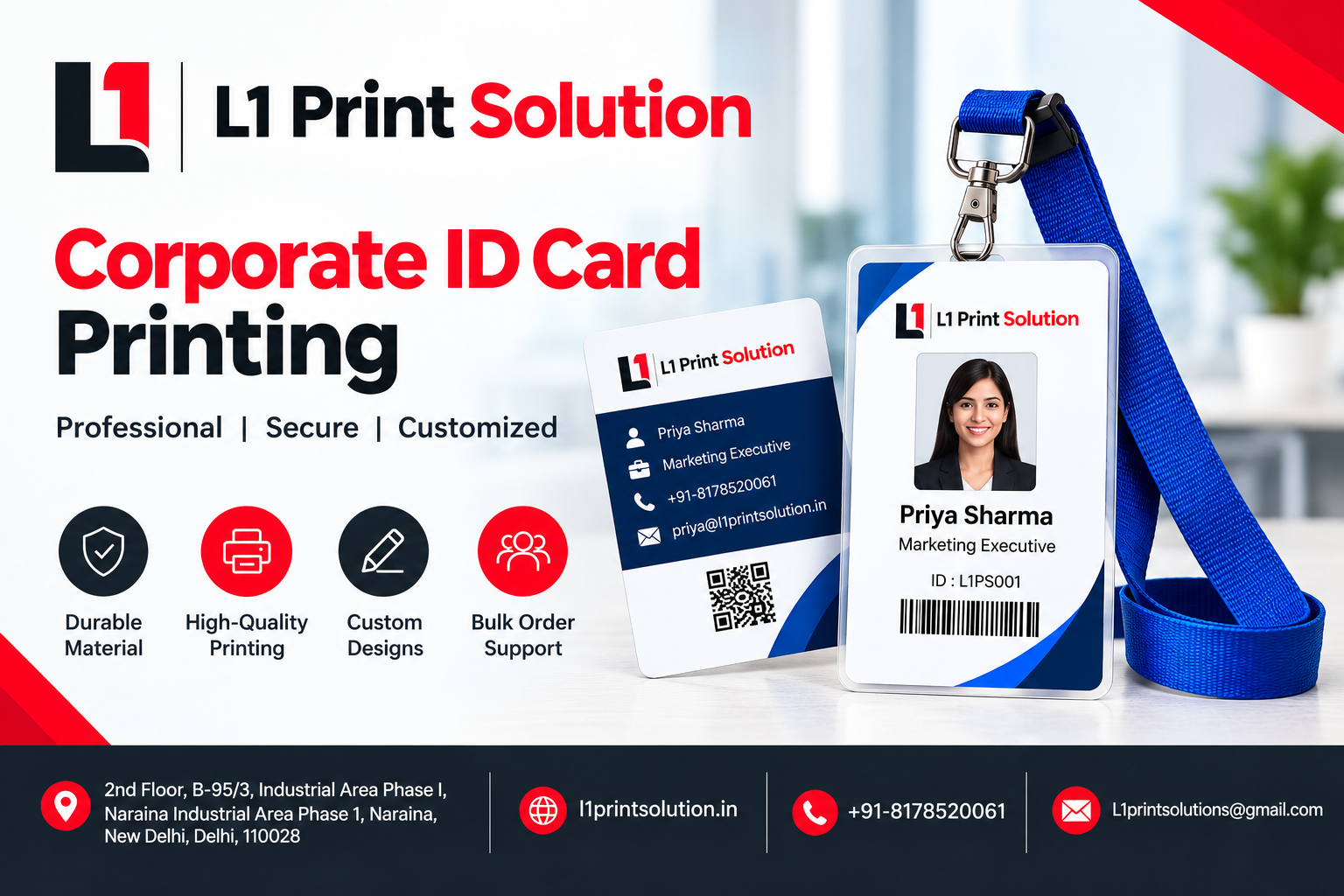
An employee ID card is a small object that does a surprising amount of work. It tells a receptionist who belongs in the building. It tells a client which company the person across the table represents. It tells a new joiner, on day one, that they are now part of something organised.
Corporate ID Card Printing is the process of producing those cards to a consistent standard, with each employee’s details printed accurately on a durable card that carries the company’s branding. Done well, a single card format handles employee identification, visual brand consistency, workplace organisation, and optional identification features such as QR codes or barcodes where a business actually needs them.
Most organisations start thinking about this when something breaks: paper badges curl and fade, photographs are printed at different sizes, or three departments show up with three different card designs. This guide covers what goes on a professional card, how the production process works, and what to check before placing a bulk order.
Quick Answer
What is Corporate ID Card Printing and why do businesses use it?
Corporate ID Card Printing is the production of customised employee identification cards, usually on PVC, printed with an employee’s photograph, name, ID number, designation, department and company logo. Businesses use it to identify staff clearly, keep branding consistent across teams, organise the workplace, and support everyday identification needs.
What is Corporate ID Card Printing?
Corporate ID Card Printing means designing one card template for an organisation and then printing it in volume, with each card personalised for an individual employee.
The design stays fixed. The company logo, colour scheme, layout and card size remain identical across every card produced. What changes from card to card is the employee-specific data: the photo, the name, the ID number, and so on. This combination of a fixed template with variable data is what separates a professional print run from a set of one-off cards made individually.
A typical corporate card carries:
- Employee photograph
- Employee name
- Employee ID number
- Designation
- Department
- Company logo
- QR code or barcode, where a workflow requires it
- Validity dates or issue information, where relevant
Cards can be printed single-sided or double-sided. Many organisations use the reverse for terms of use, a return address, emergency contact instructions, or the barcode.
Why Do Businesses Need Professional Corporate ID Cards?
Better Employee Identification
A photograph plus a name plus a designation answers the three questions people actually ask: who is this, what do they do, and do they work here. In offices with multiple floors, shift-based teams, or frequent new joiners, this matters more than it seems. A clear, well-printed photo does more useful work than any other element on the card.
Consistent Business Branding
Employee cards are visible in meetings, at reception desks, at client sites and at events. When the logo is reproduced at the correct proportions, the brand colours match the rest of the company’s material, and the typography is consistent, the card reinforces the same identity as the website and the business card. Inconsistent cards do the opposite.
Workplace Organisation
Standardised cards give an organisation a single identification system instead of several informal ones. HR can maintain one record of issued cards, one numbering format, and one replacement process. Colour-coding or department labels can then sit within that shared system rather than replacing it.
Visitor and Workplace Management
A distinct employee card helps staff distinguish permanent employees from visitors, contractors and temporary personnel, particularly when visitor passes use a visibly different design.
It is worth being realistic here. An ID card supports identification processes; it does not by itself secure a premises. Access control, reception procedures and staff awareness do that work. The card is one input into those systems.
What Should a Professional Corporate ID Card Include?
| Card Element | Purpose |
| Company Logo | Brand identification |
| Employee Photo | Visual identification |
| Employee Name | Identifies the cardholder |
| Employee ID | Unique employee reference |
| Designation | Shows employee role |
| Department | Identifies business function |
| QR / Barcode | Supports specific identification workflows |
| Validity Information | Helps manage card lifecycle |
Include what your identification process actually uses, and nothing more. Personal details such as home addresses, dates of birth or personal phone numbers rarely belong on a card that gets left on desks and dropped in car parks. Decide the field list once, document it, and apply it across the organisation.
Benefits of Custom PVC ID Cards for Businesses
PVC is the common choice for employee identification for practical reasons rather than fashionable ones.
Durable card format. PVC handles daily clipping, unclipping, pocketing and lanyard wear far better than laminated paper or thin plastic.
Professional appearance. A standard CR80 card (85.6 × 54 mm, the same footprint as a debit card) looks deliberate and fits every commonly available holder, clip and lanyard.
Customisable design. Full-colour printing across the whole card surface allows brand colours, gradients, background graphics and logos to be reproduced properly.
Clear printing. Small text such as ID numbers and department names stays legible when printed at a sufficient resolution on a smooth card surface.
Easy personalisation. Names, photos and numbers can be varied per card within one production run.
Suitable for regular handling. Cards survive being carried every working day, which matters more than any single quality claim.
Compatible with additional features. Where required, PVC cards can carry barcodes, QR codes, magnetic stripes or holographic elements.
Actual card life depends on the finish, the handling and whether a holder is used, so treat any precise lifespan figure with caution.
How to Choose Corporate ID Card Printing Services
Comparing suppliers on price alone is the most common mistake, because the cheapest quote often excludes proofing, data checking and reprints. Evaluate the full process instead.
- Card material quality. Confirm the card thickness, size and finish before ordering.
- Printing clarity. Ask to see a sample showing small text and fine logo detail.
- Photograph reproduction. Photos are where poor printing shows first.
- Design customisation. Can the supplier work to your brand guidelines, or only to fixed templates?
- Personalisation capabilities. Variable data printing across hundreds of cards is a different job from printing one design repeatedly.
- QR and barcode requirements. If codes will be scanned, they must be generated at a scannable size and position.
- Proof approval. You should see and approve a proof before bulk production begins.
- Data accuracy. Ask how employee data is received, formatted and verified.
- Quality checking. Find out what happens if ten cards in a batch have a printing defect.
- Turnaround time. Get a realistic production window, not an optimistic one.
- Bulk-order capability. Large runs need organised batching and packing.
- Customer communication. A responsive point of contact prevents most ordering problems.
Corporate ID Card Printing Process: Step by Step
Requirement Collection → quantity, card type, single or double sided, finish, delivery date.
Card Design → the template is built using the company logo, colours and field layout.
Employee Data Collection → names, IDs, designations, departments and photographs are collected, usually as a spreadsheet plus an image folder.
Design / Data Verification → data is matched to the template; spelling, formatting and photo quality are checked.
Proof Approval → the client reviews a sample card and signs off.
Card Printing → the approved template is printed in volume.
Personalisation → individual employee data is applied to each card.
Quality Check → cards are inspected for print defects, colour consistency and data errors.
Packaging & Delivery → cards are sorted, often by department, and dispatched.
The verification and proof stages carry the most risk. A misspelled name discovered after 400 cards are printed becomes a reprint; the same error caught at proof stage takes thirty seconds to fix. Check names, photographs, ID numbers, designations and departments against your HR records before approving.
Corporate ID Card Design Tips for Professional Branding
- Keep the company logo visible and correctly proportioned
- Use your exact brand colours rather than approximations
- Make employee names the most readable text on the card
- Use high-quality photographs with consistent framing and background
- Maintain a clear visual hierarchy: photo, name, designation, then supporting details
- Avoid overcrowding; empty space makes a card look considered
- Position QR codes and barcodes where a scanner can reach them and a thumb will not cover them
- Use one layout across departments
- Review the final proof carefully before printing
For example, a company can use the same core ID card template for HR, sales, finance, operations and management while changing only the employee-specific information. If departments need to be distinguishable at a glance, change a single accent element such as a colour bar, rather than redesigning the card.
Corporate ID Card Printing vs. Basic Office ID Card Printing
| Factor | Basic Office ID Card | Professional Corporate ID Card |
| Design | Simple | Brand-focused |
| Personalisation | Basic | Detailed |
| Branding | Limited | Consistent |
| Employee Information | Essential details | Structured information |
| QR / Barcode | Optional | Based on requirements |
| Bulk Management | May be basic | Designed for organised production |
| Use Case | Basic identification | Identification + professional presentation |
Common Mistakes to Avoid When Ordering Corporate ID Cards
- Choosing only on price. The cheapest quote rarely includes reprints for errors.
- Using poor-quality photographs. Low-resolution phone images print badly at any card quality. Set a minimum resolution and a consistent background before collecting photos.
- Providing incorrect employee data. Export from your HR system rather than retyping.
- Overcrowding the design. Every extra field reduces the readability of the important ones.
- Skipping proof approval. This is where errors become expensive.
- Using inconsistent designs. Separate templates per department defeat the purpose.
- Not planning replacement cards. Cards get lost; agree a reorder process in advance.
- Not confirming specifications. Thickness, finish and single or double sided printing should be written down.
- Ignoring delivery timelines. Bulk runs need lead time, especially before an onboarding date or an event.
How L1 Print Solution Supports Professional Card Requirements
L1 Print Solution is a New Delhi–based printing business that, according to its listed company information, was established in 2012 and provides customised printing and promotional products for corporate organisations, institutions and events.
PVC cards and ID cards appear among its product categories, alongside related items such as ID card lanyards, printed lanyards and event cards, which covers most of what an organisation needs to issue a card and put it around an employee’s neck.
If you are approaching them with a requirement, it helps to have the following ready:
- Card quantity, including a small buffer for replacements
- Design requirements, brand colours and logo files
- Employee information in a clean spreadsheet
- Personalisation needs, including any QR or barcode requirement
- PVC card specifications: size, thickness, finish, single or double sided
- Delivery location and required date
Supplying these upfront usually shortens the quotation and proofing cycle considerably.
Corporate ID Card Printing for Different Industries
Corporate Offices. Employee identification, department organisation, and a consistent look across teams and office locations.
Schools and Universities. Staff and administrative identification, useful on campuses where parents and visitors need to recognise employees quickly.
Hospitals and Healthcare Organisations. Employee and department identification across large sites with shift-based teams and many roles.
Hotels and Hospitality. Staff identification in guest-facing roles, where a well-presented card contributes to the overall impression of the property.
Events and Organisations. Crew, staff and authorised personnel identification, often issued temporarily and distinguished by role.
Frequently Asked Questions
What is corporate ID card printing?
Corporate ID card printing is the production of customised employee identification cards for an organisation. A single branded template is designed, then printed in volume with each card personalised using the employee’s photograph, name, ID number, designation and department. Cards are usually produced on PVC in the standard CR80 size.
How long does bulk employee ID card printing take?
Turnaround depends on quantity, card specification and how quickly the proof is approved. The design and data verification stages usually take the longest, because employee information must be checked before production. Ask your supplier for a written timeline and allow extra time if cards are needed for a specific onboarding date or event.
Are PVC cards better than laminated paper ID cards?
PVC is generally preferred for employee identification because it withstands daily handling, clipping and lanyard use better than laminated paper, and it holds full-colour printing cleanly. Laminated paper cards cost less initially but tend to bend, peel and fade faster, which leads to more frequent replacements.
What information should be printed on an employee ID card?
Include only what your identification process needs: a photograph, employee name, employee ID, designation, department and the company logo. Add a QR code or barcode if a system will scan it, and validity information if cards expire. Avoid personal details such as home addresses or dates of birth.
Can ID cards include QR codes or barcodes?
Yes. QR codes and barcodes can be printed on PVC ID cards where an organisation uses them for attendance, verification or internal workflows. They need to be generated at a scannable size and placed where a reader can access them. Confirm the code format with your supplier before production.
Conclusion
A professional corporate ID card does several jobs at once. It identifies employees clearly, carries the company’s branding consistently into every room a staff member walks into, and gives HR a single organised system for issuing and replacing cards.
The quality of that outcome is decided less by the card itself than by the process behind it: an uncluttered design, accurate employee data, a properly reviewed proof, and a production run that is checked before it ships. Get those right and the card looks considered for as long as the employee carries it.
Looking for professional Corporate ID Card Printing for your employees or organisation? Contact L1 Print Solution to discuss your card design, quantity, personalisation and printing requirements. Call now or request a quote for your customised ID card project.
Visit Website : https://l1printsolution.in/
Call: +91-8178520061
Email: L1printsolutions@gmail.com
Address: 2nd Floor, B-95/3, Industrial Area Phase I, Naraina Industrial Area Phase 1, Naraina, New Delhi, Delhi, 110028